
The Unknown Quest Global Traditions File 04
Light & MemoryVėlinės & Dziady
Across Lithuania and the wider Slavic world, autumn remembrance turns cemeteries into oceans of flame—while older traditions remember a time when the dead were not only mourned, but fed, warmed and welcomed.
The quiet power of remembrance
One flame.
One remembered life.
In Lithuania, the beginning of November can transform a cemetery after dark. Families arrive with candles, flowers and the practical tools of care: graves are tidied, headstones cleaned and names visited again.
Modern Vėlinės, observed on 2 November, sits beside All Saints’ Day on 1 November. In practice the two days often flow into one another, and cemetery visits can be especially intense on the first. The effect is extraordinary: thousands of small lights spread through burial grounds until the cemetery itself appears illuminated from within.
Further west and south in the Slavic world, older traditions remembered under the name Dziady describe a more explicitly reciprocal relationship with ancestors—food offered at graves, fires lit, and the dead imagined as temporarily returning to the company of the living.
Archive chapter 01
Why so many
candles?
Lithuania’s official tourism material describes Vėlinės as a day dedicated to tending graves, lighting candles and remembering the departed. In Vilnius, cemeteries such as Rasos become particularly striking as thousands of lights cover their hills and paths.
The candle is simple enough to be repeated endlessly. One flame may mark one grave, one relationship or one act of care; multiplied across an entire cemetery, private remembrance becomes a visible communal event.
The symbolism attached to fire is older than the modern Catholic calendar. Baltic and Slavic traditions also preserve stories of fires warming or guiding visiting souls. That does not mean every modern candle is consciously understood as a pagan survival—but the visual continuity is powerful.
A cemetery of thousands of lights does something a monument cannot: it shows remembrance one person at a time.
The Unknown Quest · Cultural ArchiveThis is the central idea of the page: memory is not left abstract. It is made physical through cleaning, walking, lighting, visiting and standing beside the names of the dead.
Archive chapter 02
Vėlinės:
the cemetery becomes a vigil
Lithuania’s modern observance is quieter than many of the festivals elsewhere in this collection, but quiet does not mean passive. Remembrance is performed through repeated acts of care.
Archive chapter 03
Dziady:
hosting the ancestors
The dead were guests, not abstractions.
Polish cultural sources describe older Dziady rites as seasonal gatherings in which ancestors were believed able to return to the world of the living. Food, drink and fire helped maintain a reciprocal relationship across the boundary of death.
Food at the grave
Bread, honey and other foods were left near burial places or included in cemetery feasts as gifts for returning ancestral souls.
Fires for warmth and direction
Historical descriptions refer to fires kindled for spirits and to lights or burning wood used to mark routes through the landscape.
Reciprocity
The relationship was two-way: the living offered hospitality and remembrance, while ancestors could be imagined as protecting, advising or influencing the community.
Literary afterlife
Adam Mickiewicz’s drama Dziady made the ancestral rite a permanent part of Polish cultural memory, even as older folk practice declined.

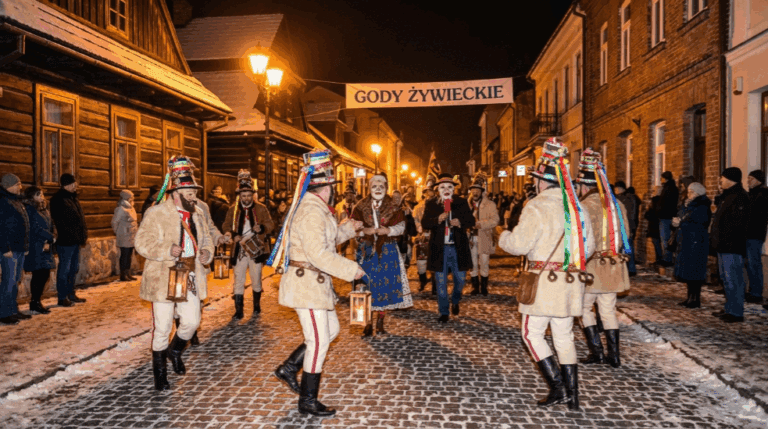
These are not the ancestral Dziady described above.
Your photograph shows Gody Żywieckie / Dziady Żywieckie, a New Year and winter masquerading tradition from the Żywiec region. It shares the word “Dziady,” and scholars sometimes discuss ideas of masking, liminality and mediation around it, but it is a distinct custom from the autumn ancestral rite associated with feeding and welcoming the dead. Keeping that distinction on the page prevents a very easy image-caption mistake.
Archive chapter 04
What survived
the changing calendar?
Christianity did not simply erase older relationships with the dead. Across centuries, practices changed, merged and were reinterpreted. The result is continuity without pretending everything remained unchanged.
Vėlinės and All Souls
The modern 2 November observance is Christian in calendar and language, while cultural memory also preserves older Baltic ideas about the dead returning during autumn.
All Saints, Zaduszki & Dziady
Contemporary cemetery candle traditions sit beside historical memories of Dziady rites in which ancestors were fed, warmed and ritually received.
Memory becomes action
Across both traditions, remembrance is expressed through doing: returning to graves, lighting fire, carrying food, speaking names and making space for the dead within community life.
If you visit
The cemetery is
not a light show.
Candlelit cemeteries are extraordinarily beautiful, which makes them increasingly attractive to visitors and photographers. But the lights exist because people are visiting their dead. Treat the visual spectacle as a consequence of remembrance—not the purpose of it.
Research trail
Follow the
source material
This version separates contemporary Lithuanian Vėlinės from historical Slavic Dziady, and also distinguishes the unrelated Dziady Żywieckie winter masquerade visible in one of the page’s photographs.