
The Unknown Quest Vault Collection 06
Global Traditions& Festivals
Five living and historical traditions. Five very different ways of welcoming, feeding, guiding, remembering and embodying relationships with the dead.
One boundary. Different answers.
What do the living
owe the dead?
Across cultures, death does not always end a relationship. People continue to feed, visit, guide, invoke, remember and make space for those who are no longer physically present.
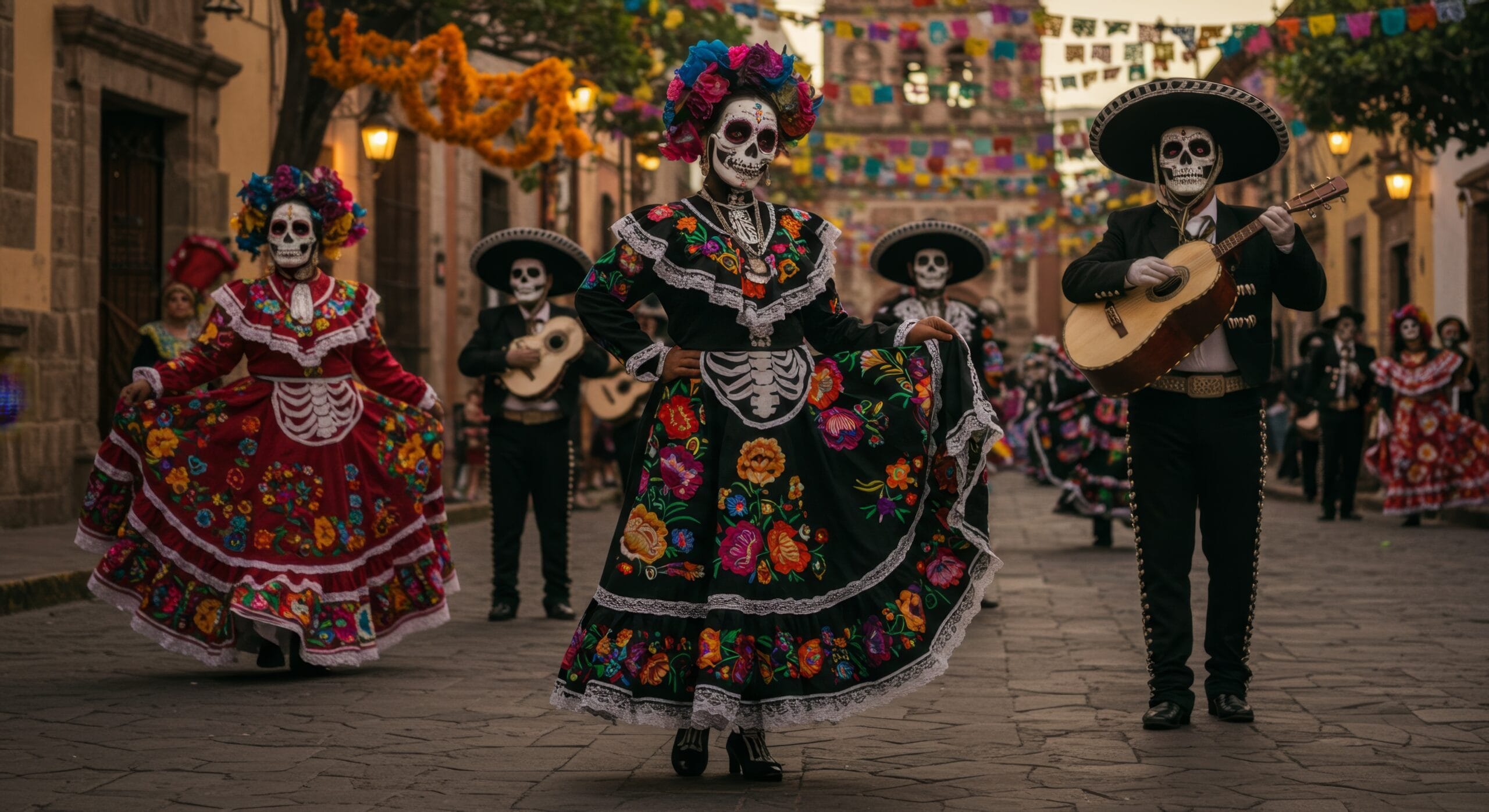
This collection follows five traditions where that relationship becomes especially visible. In Mexico, loved ones are welcomed with ofrendas and marigolds. During Chinese Ghost Month, ancestors and wandering spirits are provided for. In Japan, Obon gives the dead a carefully marked journey home and back again.
Lithuania’s Vėlinės turns whole cemeteries into fields of candlelight, while older Slavic Dziady traditions remember ancestors as guests who could be fed and warmed. In Yoruba Egúngún traditions, ancestry becomes something more physical still: lineage forebears are embodied through masquerade, movement, cloth and sound.
Browse the archive
Five traditions.
Choose a path.
Each file is a standalone deep dive with its own imagery, cultural context, visitor guidance and research trail.
Mexico’s Día de Muertos
Ofrendas, cempasúchil, candles and favourite foods turn remembrance into hospitality for loved ones believed to return home.
Hungry Ghost Festival
During the seventh lunar month, offerings extend beyond family ancestors to wandering spirits who may have no household waiting for them.
Japan’s Obon Festival
Welcoming fires, family altars, communal dance and farewell lanterns give ancestral return a beginning, a stay and an ending.
Light & Memory: Vėlinės & Dziady
Candlelit graves, ancestral food and older traditions of hospitality make memory visible across Lithuania and the wider Slavic world.
The West African Egúngún
Layered cloth, concealment, drumming and movement make lineage ancestry a public presence rather than a distant memory.
Across the collection
Five ways of crossing
the boundary
The most revealing comparison is not which tradition is “spookiest.” It is what kind of relationship each one imagines between the living and those who have died.
Día de Muertos
Loved ones are prepared for as returning family: recognisable individuals with favourite foods, photographs and places at the table.Hungry Ghost
Ritual hospitality extends beyond lineage to wandering or neglected spirits who may have no descendants making offerings for them.Obon
Fire and light mark an ancestral journey: spirits are welcomed home, remain with family and are then guided back.Vėlinės & Dziady
Graves, candles, food and older ancestral rites turn continuity with the dead into visible acts of care.Egúngún
Ancestry enters public space through a fully concealed masquerade whose cloth, movement and sound give lineage forebears visible presence.What the comparison reveals
Similar questions.
Different worlds.
Do not flatten the differences.
Flowers, candles, food, masks and lanterns can look superficially comparable in photographs. Their meanings are not automatically interchangeable. A grave candle in Lithuania, an ofrenda in Mexico and a Yoruba masquerade belong to different religious, historical and social systems.
How we approach the collection
Curiosity without
flattening the culture
The Unknown Quest is interested in what people believe, experience and preserve—not in forcing every tradition into the same paranormal explanation. That makes the strange parts more interesting, because we can actually see what each community says the ritual is for.
Research across the collection
Five files.
Five source trails.
Rather than forcing one bibliography onto five unrelated traditions, each article carries the sources most useful to that specific culture and practice.
Across the collection these include UNESCO, national heritage bodies, museums, cultural institutions and official tourism or municipal sources, alongside carefully selected historical and academic material where it adds something the institutional record cannot.
Mexico
UNESCO, INAH, UNAM and Mexican public cultural institutions.
China & Hong Kong
Hong Kong Government Records Service, intangible-heritage records and cultural bodies.
Japan
Japan National Tourism Organization and Kyoto municipal cultural guidance.
Lithuania & Poland
Lithuanian tourism sources, Polish cultural institutions and regional documentation.
Yoruba West Africa
Smithsonian, British Museum and UNESCO documentation of Yoruba masquerade traditions.
The collection begins here
Choose a tradition.Follow it properly.
Start anywhere. Follow one tradition into its own history, imagery, regional variation and source trail—or return to The Vault and continue into investigations, field reviews and the rest of The Unknown Quest archive.