
The Unknown Quest Global Traditions File 02
China’sHungry Ghost Festival
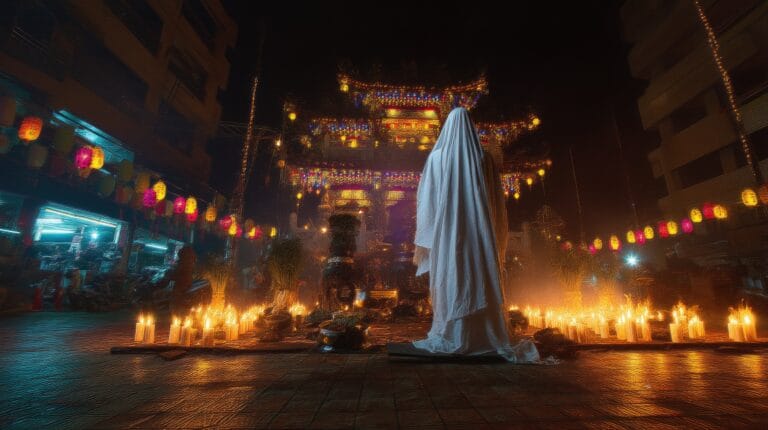
During the seventh lunar month, the boundary between worlds is treated with caution. Ancestors are honoured, wandering spirits are fed, paper offerings burn at the roadside and whole communities make room for the unseen.
Not every returning spirit is family
Hospitality for
the forgotten dead.
The Hungry Ghost Festival sits within a wider seventh-lunar-month season often called Ghost Month. The central idea is not simply that ancestors return. In many traditions, the living must also account for spirits who have no descendants, no regular offerings or no secure place within a family line.
That distinction gives the festival a very different atmosphere from Día de Muertos or Obon. Family ancestors may be honoured at household altars, while food, incense and paper offerings are also placed in public spaces for wandering spirits—the unknown dead who are not being welcomed home by anyone in particular.
The result is a tradition built around reciprocity, ritual duty and community balance. The unseen are acknowledged, fed and provided for so that relationships between the living, ancestors, deities and wandering dead remain in order.
Archive chapter 01
The month when
the unseen draws near
Across many Chinese folk traditions, the seventh lunar month is regarded as a period when wandering spirits are unusually close to the world of the living. Popular language often describes the gates of the underworld opening, allowing the dead to move through ordinary human space.
The fifteenth day is especially important in many calendars, but official Hong Kong records show just how much local practice varies: Yu Lan observances may take place on different days throughout the seventh lunar month depending on community and tradition.
That flexibility matters. Ghost Month is not one rigid ceremony followed identically everywhere—it is a network of related rites shaped by family, locality, dialect group and religious tradition.
The living do not need to know a ghost’s name before deciding it should be fed.
The Unknown Quest · Cultural ArchiveThis is one of the festival’s most striking ideas: ritual care can extend beyond recognised ancestors. It creates a social category for the forgotten and unclaimed dead.
Archive chapter 02
Feeding, clothing &
entertaining spirits
Official Hong Kong records describe recurring Yu Lan practices including food offerings, incense, paper offerings, religious chanting, opera and the distribution of blessed or auspicious goods. Exact combinations vary.

Archive chapter 03
One festival.
Several religious threads.
The origin is not a single story.
Modern Hungry Ghost observances bring together Buddhist narratives, Taoist Zhongyuan traditions, ancestor veneration and local Chinese folk religion. Treating all of that as one unchanged ancient ritual flattens a much more interesting history.
Mulian and his mother
A major Buddhist thread centres on Mulian, a disciple who discovers his mother suffering after death and seeks ritual means to relieve her. The story became deeply associated with offerings for the dead.
Zhongyuan
Taoist traditions connect the fifteenth day of the seventh lunar month with Zhongyuan and rites involving the dead, deities and the ordering of the spirit world.
Ancestor obligations
Family offerings sit within much older Chinese traditions of maintaining reciprocal relationships with deceased relatives and lineage ancestors.
Wandering ghosts
Yu Lan practice also gives ritual attention to spirits outside the family: those without descendants, established rites or a household altar to receive them.
Archive chapter 04
Hong Kong’s
Yu Lan tradition
Hong Kong gives us unusually good documentary evidence for living Ghost Festival traditions. The Yu Lan Ghost Festival of the Hong Kong Chiu Chow community was placed on China’s national intangible cultural heritage list in 2011.
Ancestors and wandering spirits
Government archives describe Yu Lan as serving two linked purposes: worshipping ancestors while also appeasing wandering spirits from the underworld.
An opera stage with two audiences
Shengong and Chiu Chow opera form part of some Yu Lan celebrations. Performance is not merely entertainment added onto the rite—it occupies a ritual setting structured around deities, spirits and community.
A tradition that changes district by district
Chiu Chow, Hoklo, Boat People and Punti communities maintain different Yu Lan traditions in Hong Kong, with dates and ritual sequences varying by locality.
Archive chapter 05
The folklore of
Ghost Month
Ghost Month is surrounded by warnings about what not to do. These are folk beliefs rather than a single religious rulebook, and they vary enormously between families and regions. But together they show how the month can transform ordinary behaviour into something charged with risk.
Watch the archive
See Yu Lan
as living heritage
Hong Kong’s Government Records Service hosts archival material and a documentary on the Yu Lan Ghost Festival of the Hong Kong Chiu Chow community, showing the setting, rituals and efforts to pass the tradition on.
Folk Festivals in Those Days
Explore photographs, archival material and official documentary footage covering Yu Lan festival practice in Hong Kong.
Open official archive →Research trail
Follow the
source material
The strongest documentation for this page comes from Hong Kong’s heritage, government and archival bodies, where Yu Lan remains a living community tradition.