
The Unknown Quest Global Traditions File 03
Japan’sObon Festival
Each summer, families prepare for an extraordinary homecoming: ancestors are welcomed with fire, honoured through food and prayer, celebrated in communal dance and finally guided back with light.
A festival built around return
The dead are
welcomed home.
Obon—or Bon—is one of Japan’s major annual periods of ancestral remembrance. For several days, the boundary between family history and the present is treated as temporarily open: deceased relatives are believed to return, spend time among the living and then depart again.
The festival is Buddhist in character, but its modern form is woven through household custom, regional folk practice and community celebration. Grave visits, family altars, welcoming fires and communal dance all appear within Obon, although no single household performs every practice in exactly the same way.
What gives Obon its distinctive rhythm is the three-part journey: welcome, presence and farewell. The ancestors are not merely remembered. They arrive, are received and are sent back.
Archive chapter 01
Mokuren and
the hungry ghost
One of the best-known Buddhist stories connected with Obon tells of Mokuren—the Japanese name for Maudgalyayana, one of the Buddha’s principal disciples.
In the story, Mokuren discovers through supernatural vision that his deceased mother is suffering in the realm of hungry ghosts. Unable to free her by his own power, he turns to the Buddha for guidance and is instructed to make offerings to the monastic community.
The narrative became closely associated with Ullambana rites and with Buddhist ideas of transferring merit to the dead. In popular retellings, Mokuren’s relief after his mother is released is also linked with the celebratory spirit of Bon Odori.
Obon does not frame remembrance as stillness. The ancestors arrive, the family gathers, and life moves around them.
The Unknown Quest · Cultural ArchiveThat Buddhist story matters, but it should not be treated as the only origin of every Obon custom. The festival that exists across Japan today has accumulated regional practices, household rites and local dance traditions over centuries.
Archive chapter 02
Preparing the way
home
Before celebration comes preparation. Families may clean ancestral graves, prepare the household Buddhist altar and create symbolic guides for the returning spirits.
Archive chapter 03
Bon Odori:
when remembrance dances
There is no single Bon dance.
Bon Odori is a family of regional communal dances associated with the Obon season. Music, costume, choreography and even the arrangement of the dancers vary from place to place.
Dance as community
Many Bon Odori are structured so visitors and local residents can join in, turning ancestral remembrance into a shared public event.
Regional identities
Local dances carry their own histories. Tokushima’s famous Awa Odori, for example, has several competing origin traditions and developed its own distinctive performance culture.
Music and rhythm
Taiko, flutes, shamisen, bells, recorded songs or regional folk music may accompany the dance depending on the festival.
Celebration beside remembrance
Obon demonstrates that honouring the dead need not be exclusively solemn. Food stalls, yukata, music and dancing can sit beside grave visits and memorial rites without cancelling their seriousness.

Archive chapter 04
The farewell:
sending them back
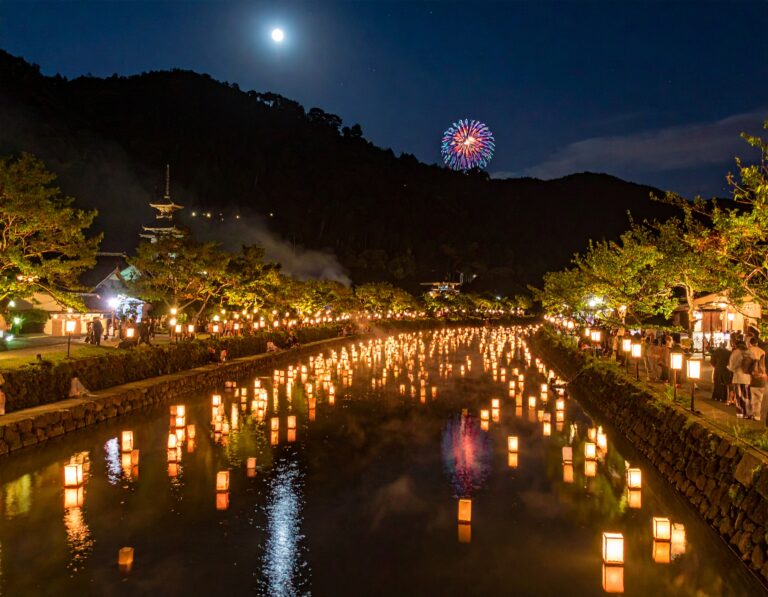
Obon must end. Just as spirits are welcomed with light, many farewell traditions use fire or lanterns to guide them away again.
Okuribi
Farewell fires mark the end of the ancestors’ stay. Japan’s tourism authorities describe them as lights that direct returning spirits back to where they reside.
Tōrō Nagashi
Floating lantern ceremonies are associated with Obon in a number of places. Lanterns released onto rivers or water create a symbolic passage away from the world of the living.
Gozan Okuribi
Five enormous fires are lit on the mountains around Kyoto. Official Kyoto guidance describes the ceremony as a send-off for ancestral spirits believed to have returned during Obon.
Archive chapter 05
One festival.
Different calendars.
Visitors often encounter one date range for Obon and assume it applies nationwide. It does not. The August observance is now the best-known modern pattern, but mid-July Bon remains important in some areas.
The most familiar modern Obon period
Japan’s National Tourism Organization describes August 13–16 as the typical modern holiday period when deceased family members are believed to return and living relatives travel home.
Shichigatsu Bon
Some communities observe Bon approximately a month earlier, reflecting the historical shift from the traditional lunar calendar to the modern solar calendar.
Other local calendars also exist. For a specific town, temple or event, always check that community’s current festival dates rather than assuming the national holiday pattern.
Watch the archive
Obon beyond
the page
The original Unknown Quest page included this accessible introduction to Obon, covering the festival’s family, ancestral and ritual dimensions.
If you visit
Join the festival.
Respect the remembrance.
Many Bon Odori actively welcome participation, but Obon also includes graves, family altars and religious rites. A public dance and a family memorial space should not be treated as though they have the same boundaries.
Research trail
Follow the
source material
This updated file uses Japanese tourism and Kyoto municipal sources for current explanations of Obon, welcoming and farewell fires, Bon Odori and Gozan Okuribi.