
The Unknown Quest Global Traditions File 05
The West AfricanEgúngún
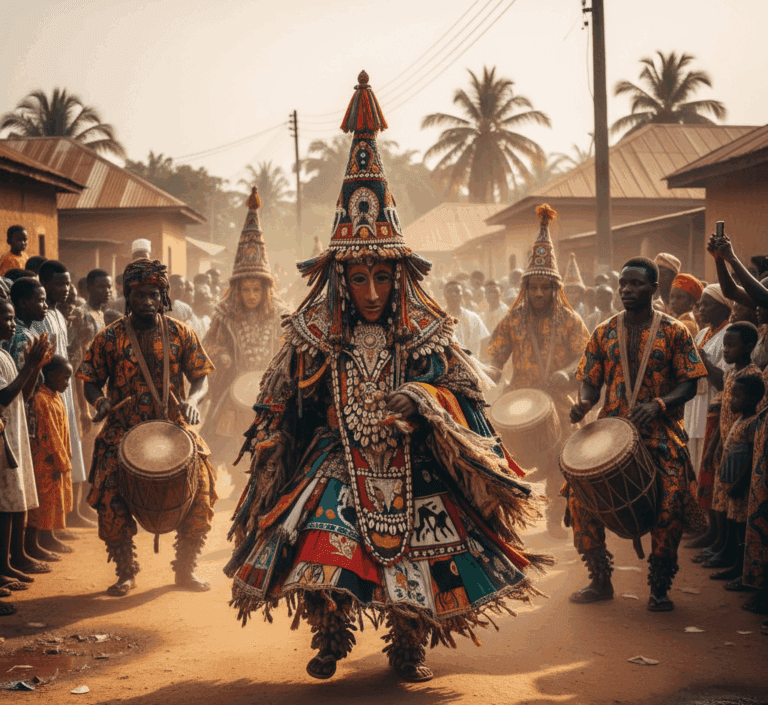
In Yoruba communities, ancestry can become movement, cloth, sound and public presence. During Egúngún masquerades, lineage forebears are not represented as distant memories—the masquerade makes ancestral power visible among the living.
The ancestor is not simply remembered
The lineage
takes visible form.
Egúngún is a Yoruba ancestral masquerade tradition found in different forms across communities in southwestern Nigeria and neighbouring parts of Benin and Togo, with related practices carried into the wider Yoruba diaspora.
Smithsonian records describe Egúngún as “powers concealed”: a term that points both to the masked performance and to the ancestral power that the masquerade embodies. During festivals such as Odun Egúngún, fully concealed performers may represent individually named ancestors or the collective forebears of a lineage.
This matters because an Egúngún should not be reduced to “someone wearing a traditional costume.” Within the ritual setting, the human wearer is deliberately concealed. What the community encounters is the public, performed presence of ancestry.
Archive chapter 01
“Powers
concealed”
In the Oyo Yoruba area, historical and museum documentation records annual or biennial ancestral festivals taking place across several weeks. Ritual activity could move between lineage compounds, dedicated ritual spaces, marketplaces and areas in front of the palace.
Egúngún can also appear in commemorative funerary contexts. The masquerade therefore belongs to a much larger relationship between lineage, death, civic memory and the continuing obligations of the living.
Some aspects of preparation and ritual knowledge are restricted, but the public appearance itself can be intensely communal: drumming, singing, chanting, praise and movement place ancestral presence in the middle of ordinary social space.
The costume hides the individual so completely that the lineage—not the performer—becomes the figure the crowd encounters.
The Unknown Quest · Cultural ArchiveThis is one reason concealment matters so much. The body underneath remains necessary, but visually and ritually it gives way to something larger.
Archive chapter 02
Cloth, wealth &
ancestral presence
There is no single universal Egúngún costume. Smithsonian collections specifically describe localised styles. What recurs is concealment, layered textile, movement and the transformation of cloth into a powerful visual statement about lineage.

Archive chapter 03
Odun Egúngún:
the town becomes a stage
Not one performance on one day.
Historical documentation from the Oyo Yoruba area describes Odun Egúngún as a sequence of rituals and public appearances unfolding over time, rather than a single parade with one standard format.
Lineage compounds
Ancestral obligation begins close to home. Smithsonian documentation records rituals performed within the compounds of the lineages that make up a town.
Public appearance
Masquerades also move into shared civic space—the marketplace, processional routes and, in some communities, areas associated with the palace.
Drumming, chanting & praise
Egúngún performance is inseparable from sound. Rhythm, song and praise create the social world through which the masquerade moves.
Individual and collective ancestors
A masquerade may honour a named ancestor, but museum documentation also describes Egúngún representing the collective body of lineage forebears.
Archive chapter 04
What does the
ancestor do?
Roles differ from one community and masquerade to another. It is safer to think in overlapping functions than to assign every Egúngún one universal job.
Keep predecessors present
The masquerade honours those who came before and makes the continuity of a family or lineage publicly visible to the living generation.
Turn memory into participation
Singing, dance, praise and public gathering mean ancestral remembrance is shared rather than confined to a private household memorial.
Carry tradition forward
Costume, music, ritual knowledge and family responsibility are transmitted between generations, allowing the tradition itself to become part of what a lineage inherits.
Archive chapter 05
Not every West African
masquerade is Egúngún
This distinction is important. West Africa contains many masquerade traditions, and even within Yoruba culture different forms serve very different religious and social purposes. Similar visual language does not make them interchangeable.
Watch the archive
See Egúngún
in movement
A still photograph can show textile and form; it cannot show what spinning cloth, drums, crowd movement and procession do to the experience. France 24 filmed a contemporary Egúngún celebration in Nigeria in 2025.
If you encounter a masquerade
Watch first.
Follow the community.
A public masquerade can be spectacular without being staged for tourists. The simplest approach is to let organisers and local spectators show you what participation is appropriate.
Research trail
Follow the
source material
This revision leans heavily on Smithsonian and British Museum documentation so the page distinguishes well-supported features of Egúngún from details that belong only to particular local traditions.