
The Unknown Quest Global Traditions File 01
Mexico’sDía de Muertos
For a few nights each year, homes and cemeteries fill with marigolds, candles, food and memory as families prepare for the return of those who have died.
A celebration of presence
Memory becomes
hospitality.
Día de Muertos is not simply a day for thinking about the dead. In many Mexican communities it is understood as a time when deceased relatives and loved ones can temporarily return, and the living prepare to receive them.
The result is one of the world’s most recognisable traditions of remembrance: photographs beside candles, paths of cempasúchil petals, food prepared for people no longer physically present, graves cleaned and decorated, and families gathering around stories that keep a person within the life of the household.
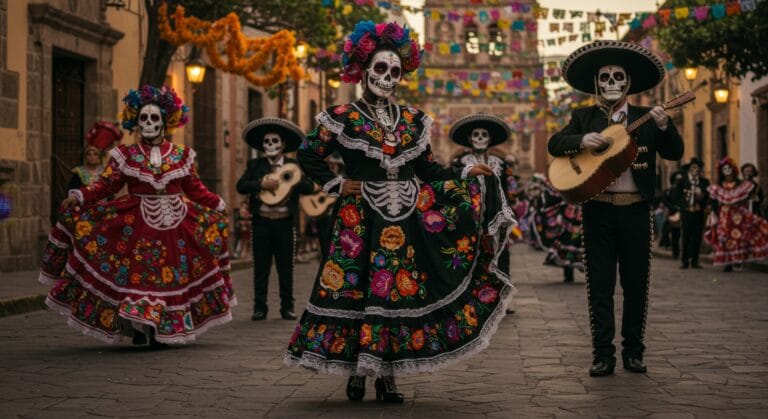
The familiar images—sugar skulls, paper cut-outs, painted faces and bright orange flowers—can make Día de Muertos look theatrical from the outside. But its centre is much more intimate. It is about relationship: who is remembered, how they are welcomed and what it means to remain part of a family after death.
Archive chapter 01
The return of
the departed
UNESCO describes the Indigenous festivity dedicated to the dead as commemorating the temporary return to Earth of deceased relatives and loved ones. The period falls around the end of October and beginning of November and, in many Indigenous communities, also coincides with the completion of the annual maize cycle.
Families may create a route for the returning souls using flower petals, candles and offerings between the cemetery and the home. Favourite dishes are prepared. Household shrines and graves become places of reception. The dead are not treated as abstract ancestors; the invitation is personal.
The altar is less a monument to absence than a place prepared for presence.
The Unknown Quest · Cultural ArchiveThis is why smell, light, taste and personal objects matter so much. The tradition does not ask a family to remember someone in generic terms. It remembers what they ate, what they drank, what made them laugh and what belonged to them.
Archive chapter 02
Reading an
ofrenda
There is no single compulsory layout used everywhere in Mexico. Ofrendas differ between regions and families, but a number of elements appear again and again because each performs a practical or symbolic role in welcoming the dead.

Archive chapter 03
The history is
more layered
There is no neat single-origin story.
Popular summaries often describe Día de Muertos as an ancient Aztec festival carried unchanged into the present. The historical picture is more complicated. Indigenous traditions surrounding ancestors and death long pre-date colonisation, while the November dates are tied to the Catholic feasts of All Saints and All Souls brought from Europe.
Indigenous worlds
Mesoamerican societies already possessed rich funerary practices, beliefs about the dead and traditions of giving food or objects to deceased people long before Spanish colonisation.
The November calendar
All Saints on 1 November and All Souls on 2 November entered Mexico through Catholic practice after the Spanish conquest.
Centuries of interaction
Today’s celebrations developed through long contact between Indigenous belief systems, Catholic observances, local customs and later national cultural forms.
A living tradition
Día de Muertos continues to change. The fact that a practice evolves does not make it less authentic; living traditions are continually recreated by the people who practise them.
Archive chapter 04
There are many
Méxicos
Trying to describe one national “correct” version misses the point. Practices vary dramatically by region, language, community and family. Mexico’s own scholars repeatedly emphasise this diversity.
Xantolo
In parts of Hidalgo, Veracruz, San Luis Potosí and Tamaulipas, the season is known as Xantolo or related local forms. Music, arches, food and community processions can form part of a much longer cycle of preparation.
Night, candles & cemeteries
Communities around Lake Pátzcuaro are especially associated with candlelit cemetery vigils and highly visible public expressions of remembrance—though local practice remains family and community specific.
Pomuch
Pomuch is known for a distinctive local practice in which families care for and clean the remains of deceased relatives, renewing the cloth in which the bones are kept before the commemorative period.

Archive chapter 05
Two dates.
Many local calendars.
The best-known national pattern centres on 1 and 2 November. A common distinction associates the first day with deceased children and the second with adults, but local sequences can begin earlier and categories vary between communities.
Children / “little dead”
In a widely recognised pattern, 1 November is associated with deceased children. Altars may include toys, sweets and objects connected to childhood.
Adult dead
2 November is commonly associated with deceased adults and with wider observances of the Faithful Departed, including cemetery visits and family gatherings.
These distinctions should be treated as a broad guide, not a rule imposed on every community. UNESCO notes that some Indigenous traditions assign days according to several categories, including age and cause of death.
Watch the archive
See the tradition
in context
UNESCO’s short documentary on the Indigenous festivity dedicated to the dead shows the celebration as community practice rather than simply as its now-famous visual symbols.
If you visit
Witness it
with respect
Día de Muertos can be spectacular, but the people beside an altar or grave may be remembering a parent, child, partner or friend. The most useful rule for visitors is simple: treat the celebration as somebody else’s family remembrance before treating it as a photograph.
Research trail
Follow the
source material
This page prioritises Mexican cultural institutions and UNESCO rather than reducing Día de Muertos to a tourism or pop-culture summary.